The world children are growing up in is changing quickly. Technology is evolving, new careers are emerging and the skills needed for the future may look very different from those needed today.
So, what does it mean to prepare a young child for that future?
Being future-ready in the early years is not about introducing more screens or expecting children to master technology at a young age. It is about helping them develop confidence, curiosity and thinking skills that can support them as the world around them changes.
At ORA Nursery of the Future, this means combining meaningful play based learning with opportunities to explore, question, create and solve problems.
What Does Future-Ready Learning Mean for Young Children?
For young children, future-ready learning begins with fundamental human skills.
These include:
Curiosity and asking questions
Creative thinking
Problem-solving
Communication
Collaboration
Independence
Confidence to try new things
Ability to learn from mistakes
These skills are not limited to one subject. They develop naturally when children have opportunities to investigate ideas, make choices and discover different ways of doing things.
Does Future-Ready Education Mean More Technology?
Not necessarily. Technology can have a place in early education when it is introduced with a clear purpose and in an age-appropriate way. But preparing children for a digital future is about much more than teaching them how to use devices.
Children first need opportunities to think, explore and understand.
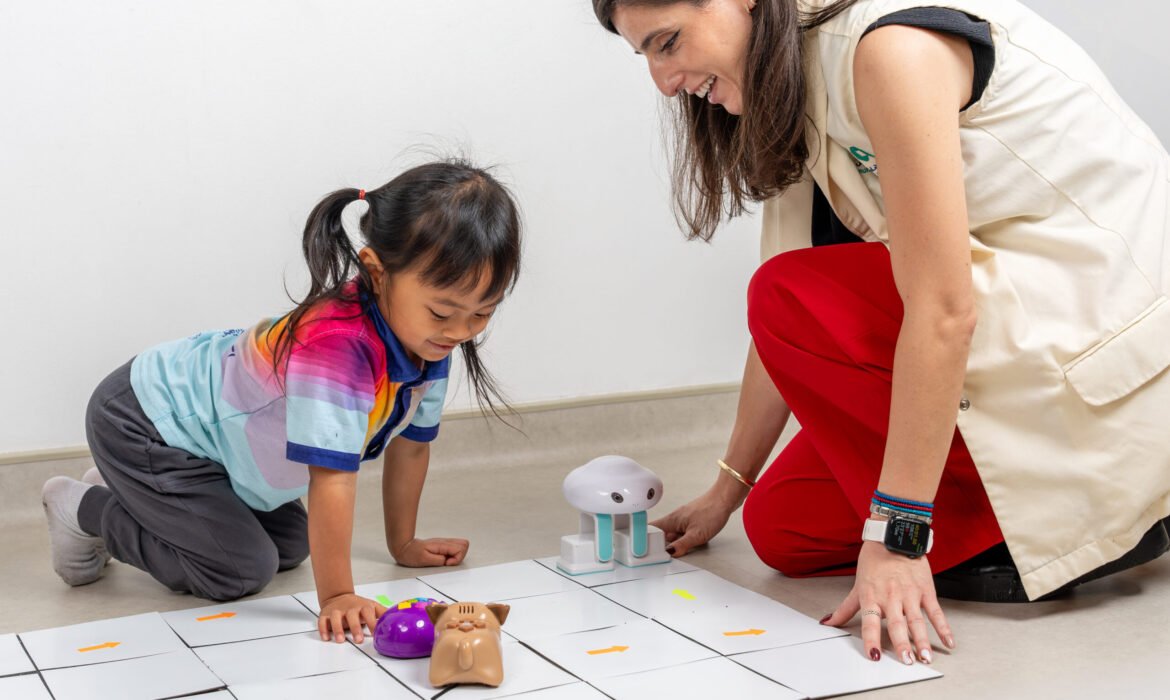
For example, building a tower involves planning and problem-solving. Sorting objects develops early mathematical thinking. Following steps in a game introduces sequencing. Working with friends encourages communication and collaboration.
These experiences create foundations that children can build on as their learning becomes more complex.
How Does Play Based Learning Develop Future Skills?
Play based learning gives children an active role in discovering how things work.
Imagine a child building a bridge with blocks. It falls down. They try again.
This time, they change the base, use different blocks or ask another child for help.
Within one simple experience, the child is experimenting, making decisions, solving a problem and responding to an unexpected result. This is why meaningful play is more than entertainment. It can encourage children to become active thinkers rather than simply waiting to be given an answer.
Why Are Curiosity and Creativity Important?
Technology will continue to change, but children will still need to ask good questions and think of new possibilities. Curiosity encourages children to ask “Why?”, “How?” and “What happens if…?”
Creativity helps them imagine different answers.
When early learning environments give children opportunities to investigate their own ideas, children begin to understand that learning is not always about finding one correct answer. Sometimes it is about exploring different possibilities.
What Should Parents Look for in a Future-Ready Nursery?
Parents searching for the best British nursery in Dubai may naturally consider curriculum, educators, facilities and school readiness.
It can also be useful to ask how the nursery prepares children for a changing world.
Consider questions such as:
Are children encouraged to ask questions?
Is there time for open-ended play and exploration?
How are problem-solving and creativity encouraged?
Is technology used purposefully rather than simply for screen time?
How does the learning environment encourage independence?
The answers can help parents understand the educational philosophy behind the nursery, not simply the activities offered.
Preparing for Tomorrow While Enjoying Childhood Today
Future-ready education does not need to rush children towards the future.
Young children still need time to play, imagine, build, talk, move, create and discover.
At ORA Nursery of the Future, the focus is on creating meaningful early learning experiences that encourage children to become curious, confident and independent thinkers.
Because preparing children for tomorrow begins by giving them meaningful opportunities to explore their world today.